Big J in a pocket
Since the day she launched, the battleship asked you to grab a mouse. No longer. The Big J now fights from a phone — and she does it with gestures, not a cockpit of buttons. The screen stays the ship.
What a thumb already knows
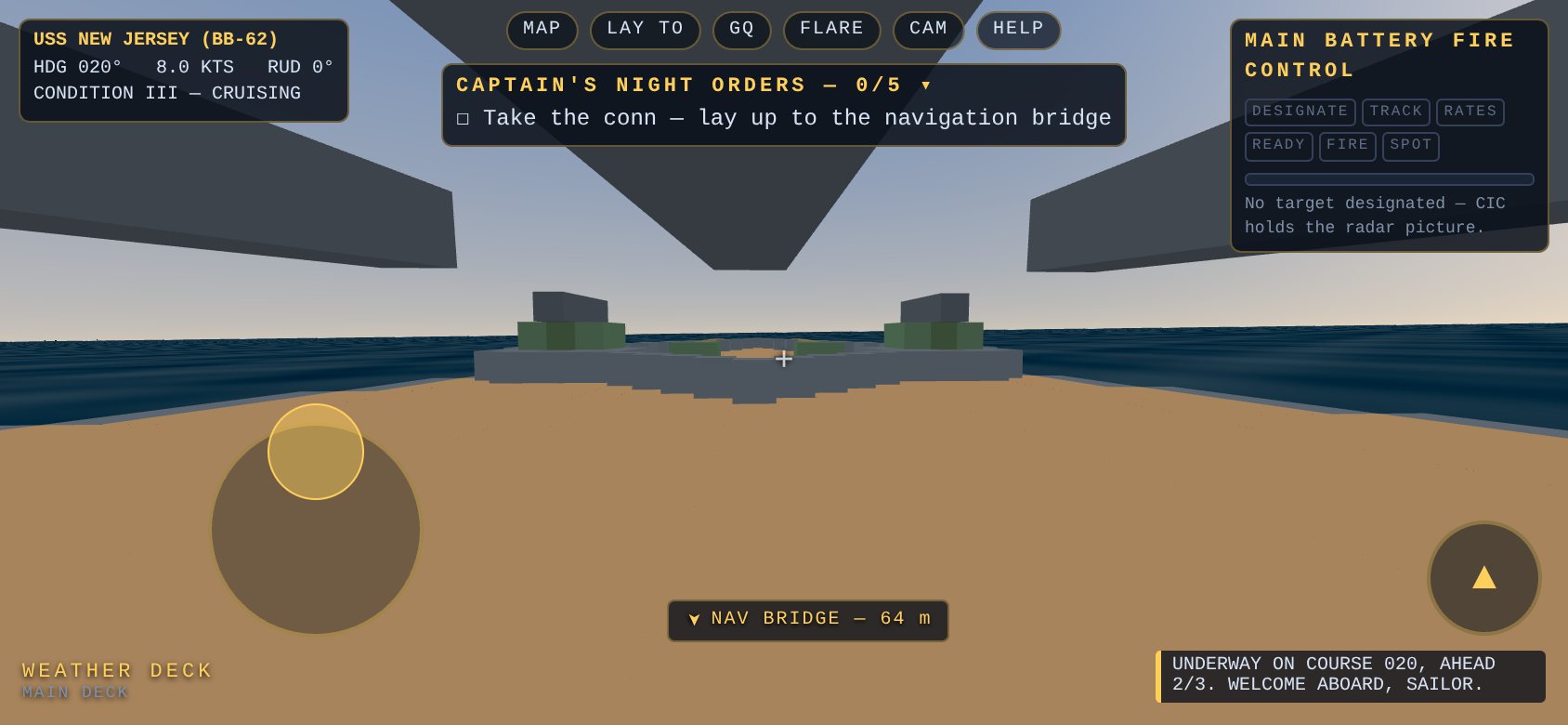
A 270-meter first-person ship with seven manned stations, ladders, binoculars, and a fire-control chain, all under two thumbs. The trick is the gold prompt at the bottom of the screen: it always knows the one thing you're standing next to, so on glass that prompt is your button. Tap it to man the helm. Hold it to fight a fire, or to reach a ladder trunk and climb down. No permanent USE key cluttering the deck — the ship tells you what's in reach and you act on it.
The rest is reflex. A joystick fades in wherever your left thumb lands and walks the deck in true analog — half-stick strolls, push to the rim and break into a run once you're already moving, so easing up to an open hatch never turns into a sprint onto the ladder. The right thumb drags to look. And the binoculars answer the gesture every phone hand tries first: pinch to raise the glasses, pinch back to drop them in the case. General quarters, the deck plans, star shells, the salvo camera, and help live in one slim strip of six chips up top — that's the whole menu.
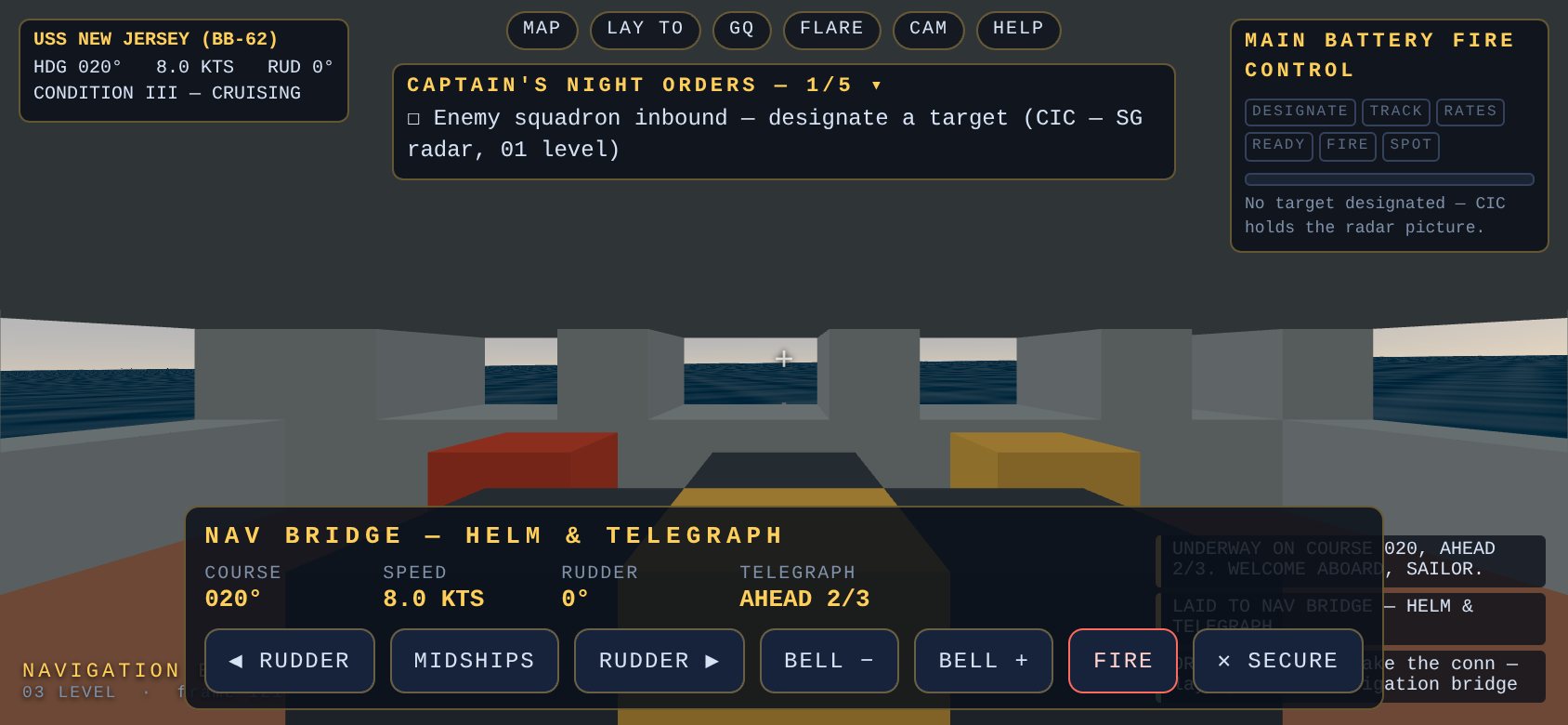
Every station laid out for your thumbs
Every battle station — helm, throttle, CIC radar, plot, director, turret II, DC central — lays its controls out as a row of labeled buttons on its own console card, live dials and all. Hold SPD + to ring up more turns; the rudder steps in the same 5° increments the desk has always used. The director keeps its full manual feel: drag the glass to slew, pinch for magnification, and work the rangefinder knob with a held button until the split images kiss.
The glass follows your finger
Once you designate a target, the director wants to auto-track it, pulling the glass back onto the bearing on its own. On touch that means your slew has to win against the tracker — and now it does. Drag the glass and it goes exactly where you put it, then settles calmly back onto the target the moment you lift your finger. Manual lay on a phone feels like manual lay should.
Made for the hand you hold it in
Starting a mission goes fullscreen and locks landscape where the phone allows it, dodges the notch, and tells a portrait phone to turn — the Big J fights broadside-on. And you feel her: every 16-inch salvo is a thump in your palm, scaled to the blow, and general quarters is the klaxon in your hand. The captain's orders fold to a one-line tally so the sky stays sky — tap them for the whole night-order book.
And if you're at a desk, the mouse still works like it always did. She's the same ship either way; she just learned to fit in one hand.