The naval playability pass
The sea war had good bones — armor and penetration, fire and flooding, torpedoes, fleets of AI ships — but the experience around them was leaking fun. So this was a broad playability pass: cut the dead time, make the gunsight teach, wake up the objective, and fix a long tail of small papercuts. Here's what changed.
Cut the sail to the fight
The worst thing a new captain could hit was the empty sail: spawn on your flank and steam three-plus minutes across open water before you saw a single enemy. Now you put to sea already close to the action — pulled in toward the nearest live capture zone, with the wide flanks left to the AI — and never dumped right on top of an enemy hull. And when you go down, a single click skips you straight to the respawn screen, so a lethal sea war never leaves you waiting to get back in.
A gunsight that teaches
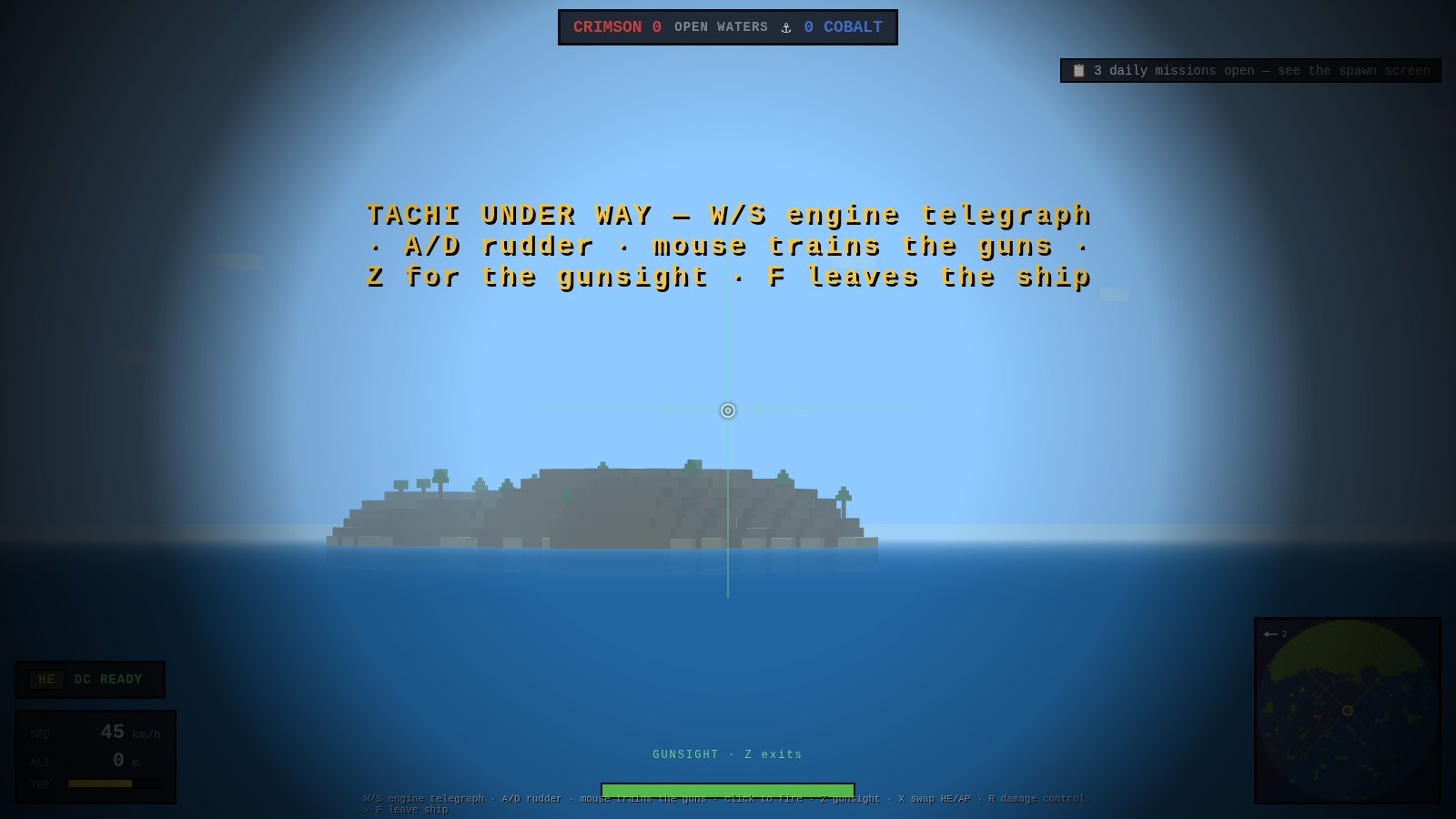
Long-range naval gunnery is a rhythm: fire, watch where the splashes fell, walk the next salvo on. So the gunsight now shows how long your shells will fly right next to the range, and its four lead ticks line up with a cruising ship's travel — so “lead two ticks” becomes a real, learnable skill instead of a guess. The fall of shot got readable too: splashes throw tall columns you can spot five kilometres off, hull hits kick a bright metal spark instead of a puff, and your last salvos linger as dots on the minimap so you can correct even on a target you can't quite see. Each ship fires a full salvo, so the spread reads as a pattern to walk in rather than one lucky coin-flip shell.
An objective that bites
The capture zones used to sit neutral almost the whole match — the fleets homed on each other and brawled wherever they met, miles from any cap, and the scoreboard read “0–0” forever. Now the ships fight and advance: a warship's turrets swing free of its bow, so an engaged hull steams onto its objective while still broadsiding the enemy, and the whole fight drifts onto the cap instead of orbiting in open water. The central zone is contested or held about a third of the match now, and rounds build to a climax at the cap instead of petering out at the bell.
Night you can see in, shoals you can dodge
Half the rounds ran after dark, and the naval night had no city glow to read hulls by — new captains had even odds of a first match where they saw nothing at all. The sea now stays bright enough to pick out ships at night, and a fresh match opens in daylight. Running aground was a silent trap, too: now a “shoal ahead” warning fires before you nose into the shallows, and a hull that does stick backs itself decisively astern instead of grinding there pinned.
The long tail
A lot of fun lives in small fixes, so the pass swept up a batch: a bearing on the “detected” banner so you know where the threat is, an incoming-torpedo warning, capture-zone and fleet-order callouts, the ship's own engine and bow-wash rumble (it used to run silent), a spectator camera that frames the fleet instead of empty ocean, the killfeed calling ship AA “ship AA” instead of “flak,” and the battleship finally tankier than the cruiser — so the top of the unlock ladder is genuinely tougher, not just better-armed.