The mouse that rolled forever
The report was one sentence: “holding the mouse still at a certain heading, the jet seems to weave back and forth, never actually achieving the desired heading — prop planes aren't affected.” All three parts were true, and in a jet the third one could get you killed.
Point at a heading and wait
Do the plainest thing a mouse can do — hold the cursor a little to one side and let the plane turn onto the new heading. In a prop this feels perfect: the nose swings around, settles into a steady bank, and rolls out on course. In a jet it fell apart. The plane would roll right over the top and keep rolling, the nose corkscrewing past the heading and back, never settling on the one you asked for. Up high you live through it — it reads as the jet weaving drunkenly through your heading. Down low it reads as a crash you didn't order: one firm drag right, held still, and a Starfang would bank past vertical, drop its nose, and fly itself into the Brick Sea in a handful of seconds.
Why a jet couldn't do what a prop could
The old mouse aim kept rolling until the turn came around — and a prop is slow enough that it does. The nose swings fast, the heading lands where you pointed, and the plane holds a bank. A jet is simply too fast to haul the nose around that hard, so the aim never got the turn it was waiting for and answered the only way it knew: roll more. Past knife-edge the pull stops turning the jet and starts pulling the nose straight into the ground, and the whole thing winds up into a spiral. The faster the jet, the tighter the trap — the very same failure the touch stick shipped with on day one, and the same cure fixes both.
Bank in, hold, roll out
Now a jet on mouse aim picks a bank and holds it: it rolls to the angle the turn needs, carves onto the heading, and rolls out wings-level on the new course — no weave, no wind-up. Aim well above or below the horizon and it still rolls into the pull for a loop or a split-S, exactly as you'd want. And prop planes fly precisely as before: the WW2 mouse feel you've tuned your hands to is untouched.
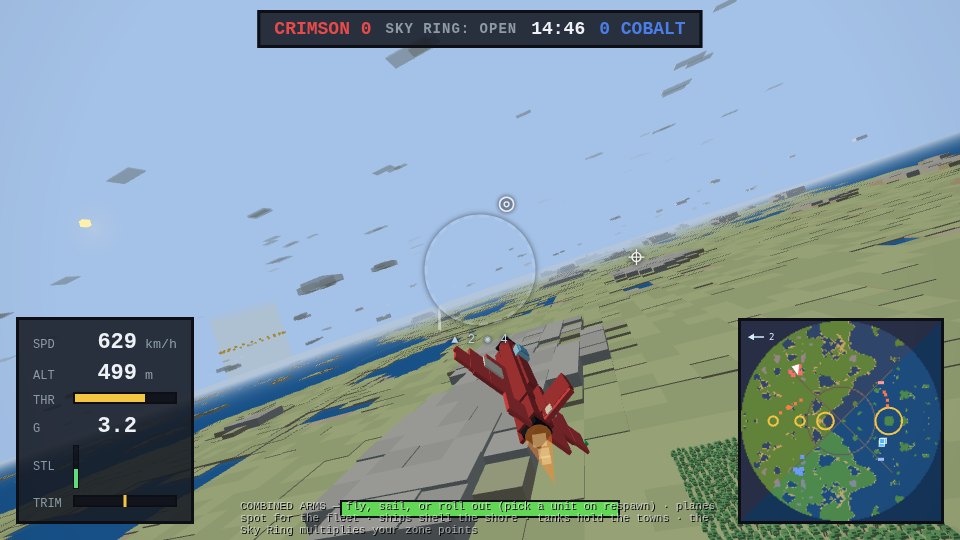
Cleaning up the weave also flushed out a smaller nag: the fine-aim was drifting a hair off the target — the sort of standing miss you'd blame on your own hand. That's gone too. Line the crosshair up on a jet now and it sits where you put it.
How it feels now
Ask for a heading off the nose and hold the mouse still: before, the jet weaved endlessly and never settled. After, it's one smooth bank in, one smooth rollout, dead on the heading, altitude held the whole way.
And the honest turn is honest now. The old mouse turn only “won” by secretly diving — banking past vertical and trading away your altitude to buy the turn rate. Mouse and touch now turn exactly the same on every jet: you keep your altitude, and nobody out-turns anybody by borrowing gravity.
The drag that used to kill the Starfang? Same gesture, same hold. It banks over, carves onto the new course, and rolls out wings-level with the altitude pinned. A hard pull still climbs, a diagonal aim still banks and climbs — the jet just does what you asked instead of what it feared.